John Deere won't climb hills?
If your mower climbs well at first, then starts losing uphill pull, reverse, or forward drive after warming up, this page covers the most likely causes, the checks worth doing first, and the repair paths that make the most sense.
Quick answer: if the mower is strongest when cold and weakest on hills once hot, the most likely problem is heat-related hydrostatic fade under load. But before you assume the transaxle is done, rule out belt slip, cooling-fan damage, packed debris, brake drag, and linkage problems.
Common symptoms
This problem usually shows up in a very specific order: the mower still feels acceptable at first, then starts failing where the load is highest.
What owners usually notice first
- The mower climbs normally at first, then loses pulling power after 15 to 30 minutes.
- It struggles on hills before it struggles on flat ground.
- Reverse gets weak before forward drive completely gives up.
- You hear a whining, humming, or groaning sound from the rear.
- The mower seems stronger again after cooling down.
- You end up mowing the steep section first just to finish the yard.
What those symptoms usually mean
Hills ask the most from the transmission. A unit that is marginal, overheated, or worn internally often still works on flat ground but cannot hold pulling force once the oil warms up.
That is why so many complaints sound the same: fine when cold, weak when hot, worst on hills.
Likely causes
The main cause is usually not a mystery, but it is easy to skip the simpler checks and jump straight to the expensive answer.
Most likely: heat-related hydrostatic fade under load
The classic pattern is a hydrostatic unit that still works while cold, then gets weak once the oil warms up and the mower is asked to pull on a slope. Hills expose the weakness first because they demand the most torque.
Possible: cooling problem around the transaxle
A broken cooling fan, packed grass, or dirt around the transaxle can trap heat and make an already-marginal unit fade sooner.
Possible: belt, idler, brake, or linkage issue
A glazed drive belt, weak idler tension, dragging brake, or misadjusted linkage can mimic transmission failure. Those checks should come before spending real money.
Possible: machine-to-terrain mismatch
Some tractors are simply asked to do more hill work than their hydrostatic setup handles well over time. That does not explain every case, but it does explain some complaints.
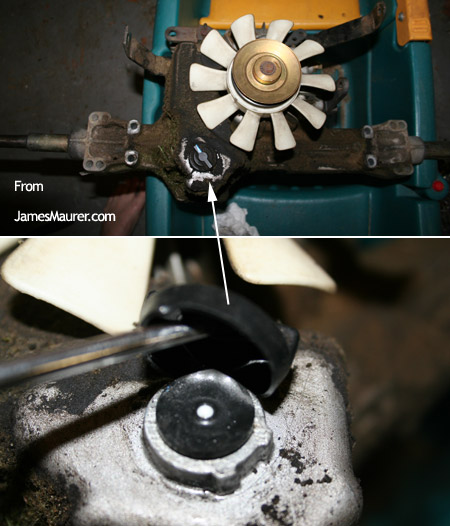
Do not overstate the diagnosis: the symptom pattern strongly suggests hydrostatic heat fade, but belts, cooling, brakes, and linkage still need to be checked before treating the transmission as confirmed dead.
Checks before replacement
These are the lower-cost checks worth doing before you spend money on a transaxle, an upgrade kit, or a replacement mower.
- Inspect the drive belt for glazing, stretching, cracking, or obvious slip.
- Verify the idler pulleys move freely and the spring tension still feels strong.
- Check the transaxle cooling fan for broken or missing blades.
- Clean grass, dust, and packed debris off the transaxle housing and cooling fins.
- Make sure the bypass or freewheel linkage is fully engaged.
- Rule out brake drag or linkage misadjustment.
- Check rear tire pressure and traction before assuming the transmission is done.
Repair paths
Once the simple checks are done, the decision usually comes down to labor, cost, and how demanding your yard is.
1) Clean and inspect before buying parts
This is the first move because it costs almost nothing. If the cooling fan is damaged or the transaxle is packed with debris, heat will make the mower fade sooner. A weak belt or dragging brake can also make a good transmission look bad.
Lowest cost, lowest risk
2) Try fluid service if the mower is otherwise worth saving
Owner reports show mixed results from fluid service. Some owners saw real improvement. Others got little benefit or only temporary improvement before the same hill-climbing weakness came back. It is a reasonable branch to test, not a guaranteed cure.
Low parts cost, meaningful labor
3) Replace the K46 with another K46
This can get the mower moving again, but it does not change the underlying limitation if you routinely mow steep hills. Like-for-like replacement makes the most sense when the mower is otherwise in very good condition and your yard is not especially demanding.
Moderate to high cost
4) Upgrade to a heavier-duty unit such as a K66
This is the more serious fix for owners who need real hill-climbing durability. It can make sense when the frame, deck, engine, and rest of the machine are still worth investing in. The downside is cost: on an older mower, the economics can get hard to justify.
Higher cost, best durability path
5) Put the money toward a better machine
If the mower already has age, deck wear, steering wear, or other issues, a heavier-duty used machine can make more sense than putting premium money into an aging frame with one major weakness.
Often the smartest long-term math
When it is probably the transmission
After the cheap checks are ruled out, the diagnosis gets much stronger when the mower keeps repeating the same pattern: strong while cold, weak while hot, and worst on hills or in reverse.
The case gets stronger when all of these are true:
- The belt and idler setup look serviceable.
- The cooling fan is intact and the transaxle is clean.
- The bypass linkage and brake linkage are working correctly.
- The mower fades after warm-up, then improves again after cooling.
- The weakness shows up under load first, especially on inclines.
Supporting page
Want the evidence trail behind this diagnosis? See the cleaned archive and timeline: John Deere owner reports by year.
If the mower will not move at all in either direction, that is a different failure with its own checklist: John Deere won't move forward or reverse.
This diagnosis guide is based on a cleaned archive of 351 useful owner reports drawn from 765 comments spanning 2009 through 2026. The archive was filtered to keep symptoms, models, hours, repair attempts, dealer feedback, troubleshooting detail, and outcome reports. Use this page to narrow the problem, then diagnose the actual machine in front of you.
FAQ
Why does my John Deere climb hills when cold but not after 15 or 20 minutes?
That pattern usually points to heat-related hydrostatic fade under load. The unit may still feel acceptable at first, but once it warms up, the hills expose its weakness.
Does this always mean the transmission is bad?
No. Belt slip, cooling-fan damage, packed debris, dragging brakes, or linkage problems can create similar symptoms. Those checks should come first.
Is changing the fluid enough to fix it?
Sometimes, but not always. Fluid service helped some owners and did very little for others. It is worth considering, but it should not be presented as a sure cure.
Why do hills show the problem before flat ground?
Because hills demand more torque. A weak hydrostatic unit may still move acceptably on flat ground but fail once the load increases.
When does a K66-style upgrade make sense?
When the mower is otherwise worth keeping and you regularly mow slopes that expose the weakness of the lighter-duty unit. If the rest of the mower is tired, buying a stronger used machine can make more sense.
Is there a separate page for the old owner-report archive?
Yes. The supporting page keeps the cleaned archive and year-by-year report timeline separate from this practical diagnosis page.