John Deere won't climb hills?
If your John Deere mower works well for the first part of the yard, then starts losing uphill pull, reverse, or forward drive after warming up, a cleaned archive of 351 useful owner reports shows the same pattern across many years and models.
Symptoms owners kept describing
The same phrases recur again and again in the cleaned comments, which is why this page stays symptom-first instead of drifting into generic transmission jargon.
What owners actually say
- Moves acceptably at first, then loses pulling power after 15 to 30 minutes
- Stops climbing even a modest hill once the transmission warms up
- Gets weak in reverse before it fully gives up
- Makes a whining, humming, or groaning noise from the rear
- Feels better again after cooling off
- Forces owners to mow the steep section first just to finish the yard
What that usually points to
A hydrostatic unit that is weak under load, wearing internally, running too hot, or no longer maintaining enough pulling force once the oil warms up. Hills expose that weakness first because they demand the most torque from the transmission.
What the cleaned archive shows
The comments become far more useful once they are distilled into patterns. Instead of hundreds of mixed replies, you can see what repeated, what changed over time, and what decisions owners actually faced.
The complaint is symptom-first, not jargon-first
The old page and the cleaned archive both revolve around the same plain-English problem: the tractor will not climb hills once it gets hot. That is the core reader intent this page satisfies.
The strongest model concentration is L120 and L130
Those two models dominate the archive, but the same pattern shows up on LA, D, X, LT, and 155C-era machines using similar hydrostatic setups.
Fluid service shows mixed results
Some owners reported improvement after fluid work or cleaning. Others said the mower still failed on hills once it heated back up. This page presents service as a branch to test, not a guaranteed cure.
The timeline matters
The comments do not describe one short-lived burst of complaints. The same symptom language continues across many years, which confirms the problem is not model-specific or generation-specific.
2009: the pattern is already obvious
In one early L120 report, the tractor would stop climbing even a small hill after about 20 minutes. Another owner said changing mowing order became necessary just to finish the hilly section before the machine got too hot.
2009: fluid service helps some, fails others
An early commenter reported that an oil change bought almost no meaningful hill-climbing improvement once the unit got hot again. That keeps the page honest: service belongs on the checklist, but not as a promised fix.
2010: reverse and rear-end whine keep appearing
By the next year, owners were describing weak reverse, whining from the back of the tractor, and units that still moved on flat ground but fell apart on any hill after warming up.
2012 onward: the archive gets more useful
Later reports add better troubleshooting detail: cooling fins packed with dirt, fan issues, rebuild attempts, dealer quotes, and the economics of replacing the transmission versus replacing the tractor.
2016: hours and heat fade still dominate
A later L130 report with roughly 200 hours described a tractor that would not pull itself on flat ground after about 20 minutes and made a loud rear-end whine before fading out.
2025: the same complaint language still exists
The final kept report in the archive still describes an LA120 doing all the things the older owners had already described. That continuity is useful evidence that the query language did not disappear.
Signal clusters from the cleaned comments
| Signal | Count |
|---|---|
| Comments mentioning hills, uphill mowing, inclines, or slopes | 121 |
| Comments with cost, price, or shipping details | 128 |
| Comments with hours-of-use detail | 109 |
| Comments mentioning fluid or oil | 80 |
| Comments mentioning K46 | 71 |
| Comments mentioning dealers | 63 |
| Comments mentioning K66 | 54 |
| Comments mentioning reverse | 22 |
| Comments mentioning whine / hum / groan / squeal | 16 |
Which John Deere models appear most often?
The archive is not limited to one mower, but the densest concentration is around the L120 and L130. That matters because it supports both the broad symptom query and the model-specific long-tail searches people use when they already suspect the transmission.
| Model | Count in cleaned archive |
|---|---|
| L120 | 57 |
| L130 | 49 |
| LA120 | 11 |
| L118 | 10 |
| X300 | 9 |
| L110 | 7 |
| L111 | 7 |
| 145 | 7 |
| LT180 | 7 |
| LA140 | 6 |
| D140 | 6 |
| 155C | 6 |
| LA130 | 5 |
Checks to make before replacing anything
Not every mower that slows on a hill has a dead transaxle. The archive contains enough belt, fan, and cooling discussion that these basics belong on the page before any replacement recommendation.
- Inspect the drive belt for glazing, stretching, or slip
- Verify idler movement and spring tension
- Check the transaxle cooling fan for broken blades
- Clean dirt and grass off the transaxle housing and cooling fins
- Confirm the bypass linkage is fully engaged
- Rule out brake drag or linkage misadjustment
- Check rear tire pressure and traction before assuming internal failure
If the machine consistently works well cold and fades only after warming up, that pushes the diagnosis back toward the hydrostatic unit rather than a simple belt issue.
Repair paths owners discussed most
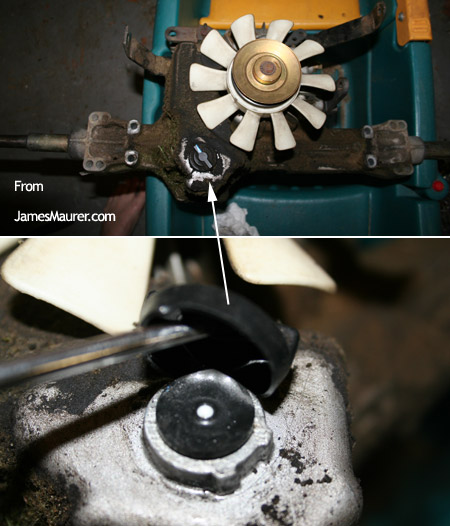
The K46 hydrostatic transaxle used in the L120, L130, and related models. The unit is sealed and non-serviceable without removal on most of these machines.
| Option | Approximate cost | Outcome |
|---|---|---|
| Fluid change and cleanup | Low - labor intensive | Mixed results in owner archive |
| Dealer K46 replacement | Around $669 | Same transmission, same limitation |
| K66 upgrade kit | Around $1,800 | Works well - math harder at current price |
| Used machine with K66 | Varies | Worth pricing before committing to kit |
Fluid change and cleanup - worth trying first
On the L120 and L130, changing the K46 fluid requires removing the transmission first, which is not a quick job. Results in the archive were mixed - some owners reported real improvement, others found the problem returned once the unit heated up again. It is a reasonable first step if the tractor is otherwise in good shape, but it is not a guaranteed cure. The cleanup side - clearing packed debris from the cooling fins and fan - costs nothing and is always worth doing before anything else.
Low cost, significant labor
Dealer K46 replacement - same unit, same outcome
The dealer option is to pull the old K46 and install an exact OEM replacement. One dealer quoted $669 including parts and labor. The problem is that you end up with the same class of transmission under the same conditions. For a tractor with significant hill-mowing demands, a like-for-like swap may buy time but not solve the underlying limitation of the K46 under sustained load.
Around $669 parts and labor
K66 transaxle upgrade - works, but the math has changed
Replacing the K46 with a Tuff Torq K66 is the upgrade that owners with serious hill-mowing needs have documented as working. The K66 is a heavier-duty unit with serviceable fluid. The upgrade was documented as a successful five-hour DIY job on an L120 - two people, basic hand tools, and a detailed pictorial manual. The result was a significant power increase and no further hill problems. The caveat is price: when this was originally done, the full kit including K66 transmission, larger wheels, and hardware cost around $1,000. The kit has since risen to around $1,800, which changes the math considerably on an older machine.
Around $1,800 for full kit as of last update
Buy a used machine with a K66 already installed
At current kit prices, buying a used tractor that already has the K66 installed is worth considering. Several Husqvarna GT models ship with the K66 as standard equipment - the GT54LS, GT48XLSi, and GT52XLSi among them. Buying used means putting a proven transmission on a machine without paying to retrofit it onto an aging frame. If the tractor is older and has other wear, this path often makes more economic sense than the upgrade kit.
Depends on used market
Questions owners asked most
Why does my John Deere climb hills when cold but not after 15 or 20 minutes?
Because the most common archive pattern is heat-related fade under load. Owners repeatedly describe mowers that work acceptably at first, then lose uphill pulling force as the transmission warms up.
Which models show up most often in the cleaned comments?
The strongest concentration is L120 and L130, followed by LA120, L118, X300, L110, L111, 145, LT180, LA140, D140, and 155C.
Is changing the fluid enough to fix the problem?
Sometimes it helped. Sometimes it did not. The comments support covering fluid service as a sensible first branch, but they do not support promising it as the cure.
How long has this been a reported problem?
The cleaned archive runs from 2009 through 2025. The same symptom language appears across all those years on multiple model generations.
Is a K66 upgrade worth it at current prices?
When the full upgrade kit was around $1,000 it was a clear win for a tractor with significant hill-mowing demands. At around $1,800 the calculation is harder. You are putting a new transmission on an older machine that may have other wear. A used tractor that already has the K66 installed - several Husqvarna GT models come with it standard - is worth pricing before committing to the kit.
What does the K66 upgrade actually involve?
On an L120, the documented install took two people about five hours using basic hand tools and a set of metric wrenches. The transmission is removed and the K66 installed in its place along with larger rear wheels that the K66 requires. A pictorial manual walks through each step. The result on one documented install was a substantial increase in pulling power with no hill problems afterward.
- If the mower stalls after 15–30 minutes rather than losing power on hills, see John Deere mower stalls: gas cap fix — a clogged vent in the gas cap is the most common cause.
- For irrigation equipment, see Sprinkler pump clicking noise: relay wire fix — covers a pump that clicks and cycles on and off from a loose relay wire.
This page summarizes first-hand owner reports, troubleshooting details, and repair discussions from an archived comment thread. Those reports are anecdotal and should be used as practical context, not as a substitute for diagnosing your specific mower.