Portable vs. stationary home generator: what I bought and why
Three stationary generator quotes ranged from $6,700 to $8,030. A portable Generac XP8000E with a manual transfer switch and power inlet cost about $2,000 total and has powered the entire house through every outage since.
The stationary generator quotes
Three companies were invited to quote a whole-home natural gas stationary generator with full installation. All three assumed an automatic transfer switch and complete electrical run.
| Company | Unit | Quote | Notes |
|---|---|---|---|
| Company 1 (Home Depot referral) | 17kW Generac | $6,700 | Included electrical run, transfer switch, $500 of gas pipe work. Salesman not permitted to discuss any brand other than what Home Depot carried. |
| Company 2 | 17kW (rebranded Generac) | $7,100 | Confirmed: Generac manufactures under multiple brand names. Same unit, different label. |
| Company 3 (Kohler) | 14kW Kohler | $8,030 | Recommended 14kW over 17kW. Kohler noted as quieter than Generac. Important: anything above 14kW may require a natural gas meter upgrade: an additional $1,700 ($485 alteration fee + $1,209 for the meter itself). |
Hidden costs with stationary units not always mentioned upfront:
- Required annual service checks (tune-up, oil change) to keep the warranty valid (required to keep the warranty active)
- Mandatory weekly 20-minute run cycles loud enough to be noticeable to neighbors
- Natural gas meter upgrade if the unit exceeds 14kW, confirmed at $1,700 additional in this case
Why portable made sense
The question was whether manually starting the generator and refilling with gasoline was acceptable. For this situation it was. No requirement for automatic startup, and no physical limitation preventing moving the unit. That made portable the right call at roughly one-third the cost.
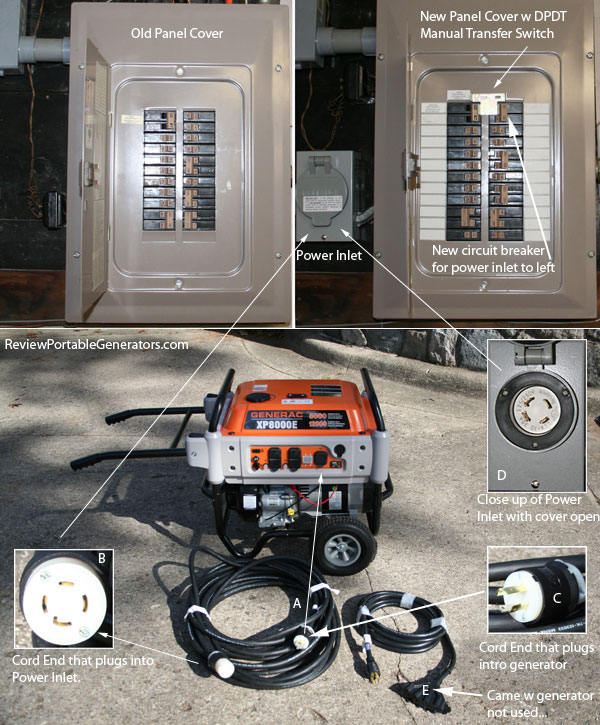
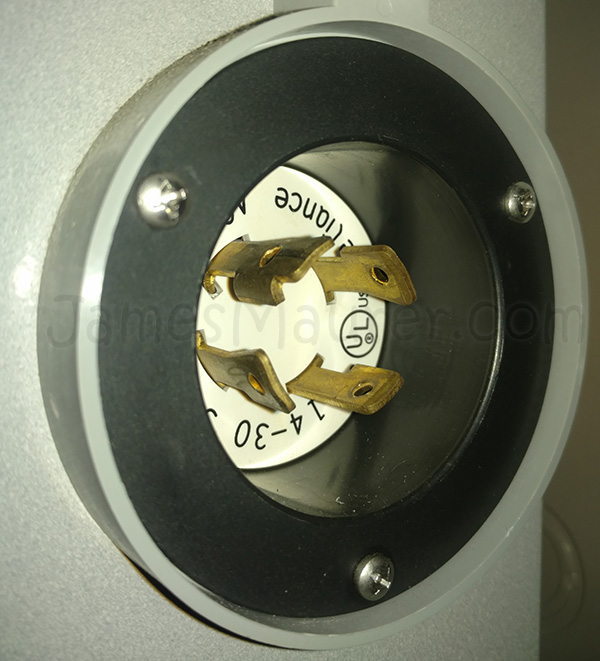
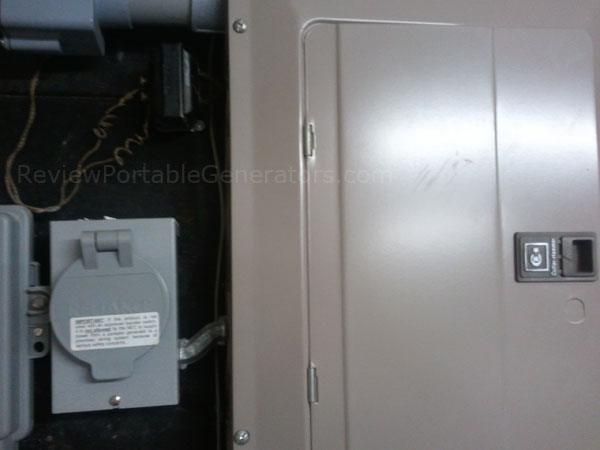
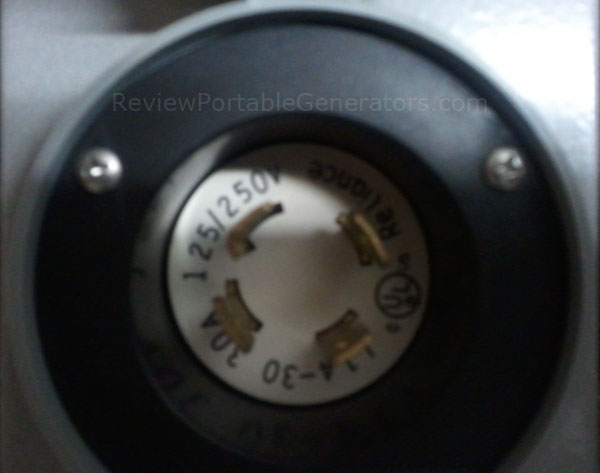
The setup: an exterior power inlet mounted to the house wall, connected through a circuit breaker to a manual transfer switch at the panel. When power goes out, the generator gets wheeled outside, the cord connects it to the inlet, and the transfer switch routes generator power through the panel.
The generator: Generac XP8000E
Purchased at Lowe's for $1,249. The XP series was Generac's premier portable line at the time of purchase, distinct from the GP and consumer-grade models. It includes TruePower technology for cleaner power output safe for electronics.
Critical: GFCI compatibility with transfer switches
The technical issue: a generator with a bonded neutral-to-ground connection cannot be connected to a home panel (which also has a bonded neutral) without the GFCI detecting it as a fault. This is not a wiring error; it is an inherent conflict when two bonded neutrals are joined.
Model-specific findings from Generac (reported at time of purchase):
- Model 5708: does not have GFCI on the 120/240V outlet. Works with a standard manual transfer switch.
- Model 5931: has GFCI on the 120/240V outlet. Will not work with a standard manual transfer switch.
- Other model numbers exist and have different configurations. The model on the store floor must be verified individually.
Generac's own phone support gave conflicting answers across multiple calls on this question. Different representatives stated opposite things about the same product. The only reliable approach is to have the specific model number on the unit looked up and the question answered in writing or escalated to a technical representative.
The unit purchased here was an older model before the GFCI change. It has worked with the transfer switch without any issues.
If a compatible unit cannot be found, the alternative is a transfer switch that switches the neutral conductor in addition to the hot legs, but these are more expensive and typically limit the number of circuits that can be transferred.
The installation
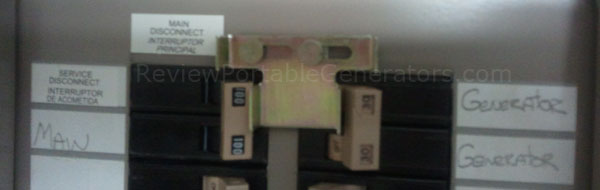
A licensed electrician installed all components. The core piece is a double-pole double-throw (DPDT) "break before make" manual transfer switch. This physically disconnects the utility feed before connecting the generator. This is what prevents backfeeding generator power onto the utility grid. Code compliance and safety for line workers both depend on this.
Correct switching sequence: safety critical
When power goes out:
- Move the manual transfer switch to the generator (emergency) position
- Move the generator outside and away from the house. Never run it indoors or in an attached garage
- Connect the generator cord to the exterior power inlet
- Start the generator
When utility power returns:
- Turn the generator off
- Disconnect the cord from the exterior inlet
- Move the transfer switch back to the utility position
Total installation cost
| Item | Cost |
|---|---|
| Permit | $80 |
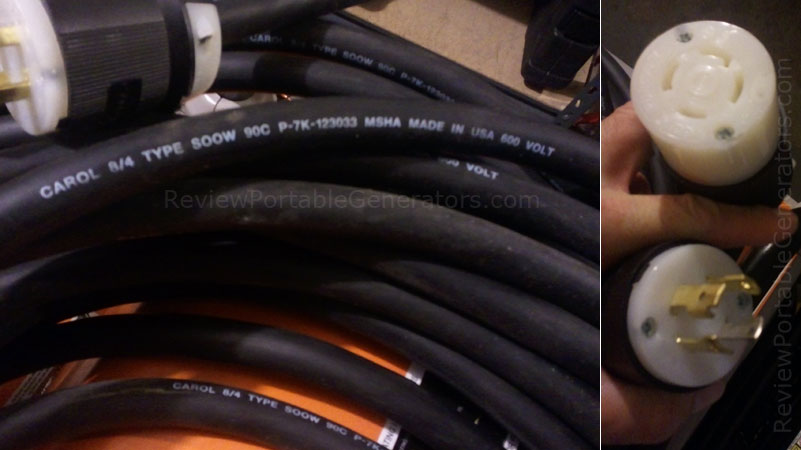
| 80-foot generator cord ($2/ft + $40/end) | $240 |
| Circuit breaker | $20 |
| Cover panel with transfer switch | $40 |
| Power inlet | $50 |
| Labor | $370 |
| Generac XP8000E (Lowe's) | $1,249 |
| Total | ~$2,049 |
The lowest stationary quote was $6,700, not including service contracts or the potential gas meter upgrade. The portable approach came in at roughly $2,000 all-in. For a situation where manual startup is workable, the cost difference is difficult to justify for a stationary unit.
What to look for when choosing a portable generator
Running watts vs. starting watts
Starting watts are always higher than running watts. That is the number that matters for anything with a motor. Refrigerators, furnace blowers, well pumps, and air conditioners draw 2–3× their running wattage at startup. Size the generator to the starting wattage of the largest motor you plan to run, not just the steady-state load. A 6,500W generator with 8,000W starting capacity handles more real-world situations than a 8,000W generator with no headroom.
Noise ratings are not standardized
Manufacturers list noise at 50% load from 23 feet. Some rate at 25% load or from 5 feet. Those numbers are not comparable to each other. A larger generator running at half capacity is often quieter in practice than a smaller one running near full load. The XP8000E is rated at 72 dB.
Fuel type
Tri-fuel models (gasoline, natural gas, propane) are worth considering for prolonged outages. Gas stations run out quickly during regional emergencies. If you have a natural gas line or a propane tank, you have fuel when others do not. The XP8000E runs on gasoline only. Plan for storage and rotation accordingly.
Tank size and actual run time
Stated run time is at 50% load. At full load (where you may actually be during a real outage), run time drops significantly. Running most of the house at roughly full load consumed approximately 13 gallons over 24 hours. Plan fuel storage accordingly and keep containers on hand.
Wheel size
Minor detail until you are moving a 200+ lb machine across a wet yard in the dark during a storm. Larger diameter wheels on rough ground and grass make a real difference. It factored into the purchase decision here.
Clean power for electronics
The Generac XP series includes TruePower technology for lower harmonic distortion. Relevant if you are running computers, flat-panel TVs, routers, or medical equipment. Some budget models without this produce power that can damage sensitive electronics. The GP series from Generac does not include TruePower; the XP series does.
This page documents a specific purchase and installation made when the Generac XP8000E was current. Generator models, pricing, and product configurations change. Verify current model numbers and transfer switch compatibility directly with Generac before purchasing. Electrical work involving transfer switches and panel connections must be performed by a licensed electrician in compliance with local code. Running a generator indoors or in an attached garage is a carbon monoxide hazard. Operate outdoors only, away from windows and doors.