Car door won't close or stay shut
The latch on the edge of the door flips into the closed position on its own. The door looks like it should close but bounces back every time. Here is what causes it and how to reset it without going to a dealer.
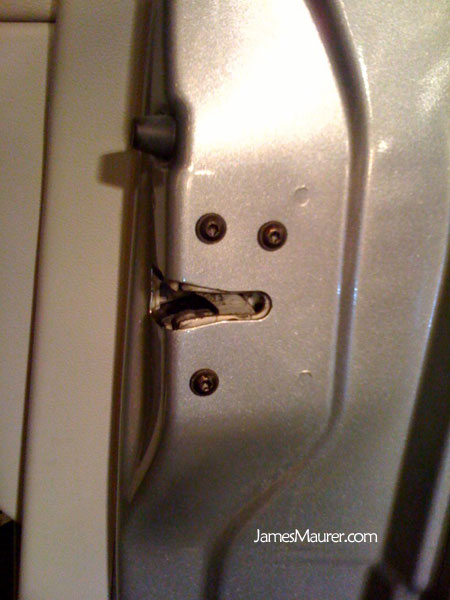
What is actually happening
Inside the door latch is a rotating catch. When the door closes normally, that catch grabs the striker post on the door frame and holds the door shut. When you pull the handle, the catch rotates back and releases the striker so the door can open.
When the door won't close, the catch has rotated into its closed position without the striker. The door hits the striker and bounces back because the catch has nowhere to go. The door was never latched, it just looked like it was.
The latch flipped closed on its own
The most common cause. The catch inside the latch mechanism rotates into the closed position without the door actually latching to the striker. This can happen if the door is opened hard and bounces, if someone pushed the latch while the door was open, or if cold weather stiffens the mechanism.
Cold weather and freezing
In cold temperatures the grease inside the latch thickens or water gets into the mechanism and freezes. The catch stops returning to its open position on its own. This is why the problem often appears overnight and clears up after the car warms up.
Hard slamming
A door slammed with excessive force can hit the striker so hard that the door bounces away from the car before the latch fully engages. The catch ends up in the closed position with nothing latched to it.
Someone moved the latch while the door was open
This is frequently what happens when someone is checking the child safety lock or cleaning the door and pushes the latch by accident. It is also how it happens to a second door when someone is trying to figure out how the first one works.
Seat belt or strap caught in the latch
A seat belt, dog leash, or bag strap caught in the door as it closes can push the latch catch into the closed position. The door appears to close but the catch is already engaged before the striker enters. Removing whatever was caught and then resetting the latch is the fix.
The fix
You need a screwdriver or a sturdy pen. The whole process takes under a minute on most vehicles.
Make sure the door is unlocked. The latch will not move if the door is in the locked position.
Pull the door handle outward and hold it. Do not let go.
While holding the handle, look at the latch on the edge of the door. You will see a small hole.
Insert a screwdriver or pen into that hole and pull it toward the front of the door.
The latch will click back into its open position. Close the door normally.
When the basic fix does not work
The steps above resolve the problem on most vehicles in most conditions. The following situations require a different approach.
The door still will not latch after resetting
If the latch resets correctly but the door pops back open when you close it, the problem is more likely the striker alignment or a worn latch assembly that is no longer gripping the striker. This is a separate issue from the latch being stuck in the closed position.
The latch releases with very little effort after closing
If the door closes but pops open easily with a light push or when another door slams, the latch catch is not holding the striker firmly. This points to a worn latch assembly rather than a latch stuck in the closed position. The screwdriver reset does not fix this - the latch itself needs replacement.
The latch is already in the correct position but the door still will not catch
In cold weather the striker opening in the latch can freeze over even when the catch itself moves freely. The door swings shut but the striker cannot enter the latch opening. A hair dryer or deicer directed into the latch from the door edge has resolved this on some vehicles. Replacing the latch on a vehicle that fails this way every winter may not help - one owner with a 2006 Ford Expedition had both latches replaced and still had the same failure on the first frost.
The problem keeps coming back in cold weather
Repeated cold-weather failures suggest the grease inside the latch has dried out or been contaminated. WD-40 is not the right solution here because it dissolves lubricant rather than replacing it. A lithium-based grease of the type used by dealers for latches and hinges is the better fix. Work the latch open and closed several times after applying it.
The outside door handle is broken
If the outside handle does not move the latch, you cannot hold it open while resetting. In that case you need to access the latch from inside the door panel or use the inside handle instead, depending on your vehicle.
The latch is in the correct position but the door still will not stay shut
On some vehicles there is a secondary latch or catch further inside the door that is not accessible from the door edge. A lock lubricant sprayed into the latch opening has worked in some cases. If that fails, the latch assembly itself may need to be replaced.
Sliding doors on vans
The same stuck-catch problem occurs on sliding doors. One owner reported it on a 2001 Ford Windstar sliding door that would close but pop back open when the driver door slammed or when the van went over a bump. The reset procedure is the same but the latch location on a sliding door is at the rear edge of the door panel rather than the side edge.
The most likely cause is that the catch flipped closed after a hard door close, a bump during cleaning, or a broken return spring. Loose door hinges can compound the problem by letting the striker hit the catch and push it closed before the door fully enters the latch opening. After resetting, work the latch open and closed several times to confirm it moves freely on its own. If it sticks, use a lithium-based grease rather than WD-40, which strips out factory lubricant and is not compatible with the bumper materials inside the latch.
Reader reports by vehicle and situation
Selected from a large number of owner reports. Only entries with useful diagnostic detail are included.
Both driver and passenger doors stopped closing at the same time. The running board also stopped deploying, which initially suggested a wiring issue. Resetting both latches resolved all three symptoms.
Recurring problem with both front doors. Had both latch assemblies replaced and still had the same failure on the first frost of the following year. Suggests the issue on this vehicle in cold weather is not simply a worn latch.
Recurring problem in cold weather. The door usually frees up after the car warms for 10 minutes, but failed to do so one morning. Resetting the latch while holding the door handle worked. Keeping a screwdriver in the car was the takeaway.
Cold weather was identified as the cause on a car that had never had the problem before. The fix worked on the first attempt.
Difficulty finding the hole in the latch. The hole on this model is present but not obvious. Once located, the fix worked normally.
The latch geometry on this model looked different and the standard fix did not work. Suggests some Fiesta configurations have a different latch design.
The sliding door would close but pop open when the driver door was shut firmly or when the van went over a bump. The latch catch was stuck in the closed position. Resetting it resolved the immediate problem. Some marks around the latch opening suggested an underlying alignment issue.
The same stuck-catch problem occurred on the rear hatch. The fix worked the same way as on a standard door.
Power locks frozen open in extreme cold. Holding the door handle while working the latch was the key step. The fix worked the same way as on modern vehicles.
Confirmed working on older Japanese market vehicles. Same latch mechanism design.
Latch was in the closed position on a vehicle from the mid-1980s. The fix worked the same way. This mechanism design has been consistent across many decades.
The latch itself was not stuck and moved freely. The door would not latch after the reset until the mechanism was warmed with a hair dryer. Suggests the striker or latch opening was misaligned when cold. The basic screwdriver fix did not work on this vehicle in cold conditions.
The main latch was not stuck. A secondary catch further inside the door was the cause. A lock lubricant sprayed into the latch from the door edge released it. The standard screwdriver approach did not reach the right part on this model.
The fix worked on the rear door of this vehicle. Same procedure as a standard door.
Several owners found the problem returned after a few weeks. Working the latch open and closed several times after resetting it, then applying lithium grease, reduced recurrence. One owner also lubricated the striker post itself.
Questions that come up most often
Why did both doors stop closing at the same time?
Usually because someone tried to diagnose the first door by looking at the second one and accidentally flipped that latch too. The fix is the same on both doors.
Is this covered under warranty?
If the latch is failing repeatedly and the vehicle is under warranty, it is worth asking the dealer to replace the latch assembly rather than just resetting it. A latch that keeps sticking likely has a weak return spring.
Should I use WD-40 to lubricate the latch?
WD-40 is a solvent, not a grease, and will strip out the factory lubricant. Use a lithium-based grease instead. Several readers found WD-40 provided short-term improvement followed by the same problem returning.
Does cold weather cause permanent damage?
Usually not. The mechanism is just stiff or frozen. Once the car warms up and the latch resets correctly, the door works normally. Repeated freeze-thaw cycles over many years can wear the mechanism faster, but a single cold-weather episode is not usually damaging.
My door flew open while driving. Is the latch broken?
Not necessarily. If the latch had already flipped to the closed position before you closed the door, the door was never latched to the striker. It looked closed but was not engaged. Resetting the latch is the first thing to try before assuming anything is broken.
The door closes now but the dashboard warning light is still on.
The door ajar sensor is a separate switch from the latch. If the door closed properly but the light stays on, open and firmly close the door again. On some vehicles the sensor requires the door to click shut with more force than expected. If the light stays on after several attempts, the door ajar sensor itself may need attention.
I can not find the hole to put the screwdriver in.
The hole is toward the back of the latch opening, not the front. Look for a small round hole in the latch housing - not the large slot the striker enters. On some vehicles such as certain Ford Focus and PT Cruiser models the hole is harder to see. If there is genuinely no accessible hole, the latch on that vehicle may require the door panel to be removed.
The fix described here works on most vehicles with a standard door latch mechanism. Not all latches are identical and some vehicle models have secondary catches or different latch geometry that the standard approach will not reach. If the door failed while the vehicle was moving, have the latch mechanism inspected before assuming a reset is sufficient.